


“We can sign if you add this integration.”
It sounds like progress. A customer wants your product and is explaining what would get the deal over the line.
Then you look at the work: an integration, a bespoke report and weekly help from your team. Your next prospect wants a different version of the same thing.
You are adding customers, but your business is becoming harder to operate.
If this sounds familiar, the decision deserves more attention than another demo or a revised proposal. You need to understand which parts of the deal create a repeatable business and which parts create a separate delivery project.
After years building and operating across sports, entertainment and B2B software, the question I would put on the table is:
What exactly are we committing to, and can we deliver it again at a cost that makes sense?
What the bigger contract leaves out
Imagine a SportsTech startup helping padel operators analyse bookings and test offers for quiet court hours. Two operators want to buy.
Operator A uses a booking system the startup already supports. An operations manager will own implementation and use the results.
Operator B has a custom system. It needs a new connector, different reports and more support. Nobody has yet confirmed who will act on the recommendations.
Here is a simplified first-year comparison:
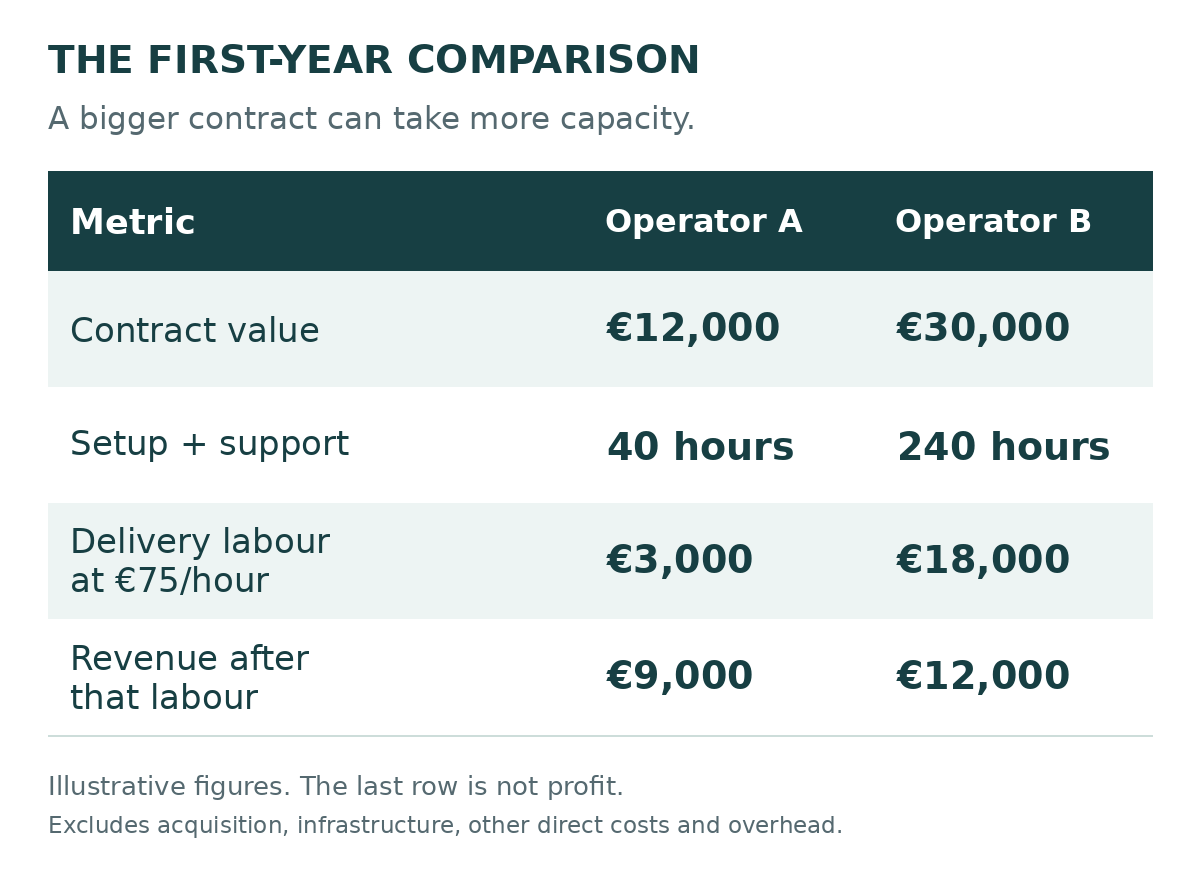
Hypothetical example. The last row excludes acquisition costs, infrastructure, other direct costs and overhead. It is not profit.
Operator B brings 2.5 times the revenue and takes six times the estimated delivery effort. It still leaves more revenue after that labour.
That can be a worthwhile deal. But the additional 200 hours have to come from somewhere. If they delay other implementations, keep the founder out of sales or push back a feature existing customers need, the contract has a wider cost.
There is also an adoption question: who will turn those reports into decisions? A customer can pay and still never build a workable routine around your product.
Before judging the opportunity, change the proposal. Price implementation separately. Confirm the adoption owner. Narrow the reporting scope. Agree what the standard subscription includes.
A difficult opportunity may need a better commercial package before it needs a rejection.
Six questions to answer before you sign
Use these questions on a live opportunity. Write the answers down with sales, product and whoever will deliver the work.
1. What happened that made the customer want to buy now?
A new venue, a deadline or a recurring operational failure gives you something to investigate. General enthusiasm for innovation tells you much less about urgency.
2. What must the customer already have for our product to work?
For the padel example, that could mean usable booking records, access to a supported system and someone authorised to run an offer. Agree how missing inputs will be resolved before committing to a timeline.
3. Who will own the first useful outcome?
Name the person and the action. “The customer will review the dashboard” is vague. “The operations manager will use the booking analysis to select a quiet period and run a test” gives both sides a clearer responsibility.
4. Which promises go beyond our standard offer?
List integrations, reports, training and manual work. Put a scope, owner and price against the material exceptions. Check what sales has implied as well as what the contract says.
5. What evidence suggests we can deliver this repeatedly?
Look for comparable customers who reached value, used the product in the intended workflow and required a sustainable amount of support. Separate proven patterns from estimates and things you hope will become easier.
6. What will we postpone if we accept?
Name the work. A trade-off that stays abstract is easy to overlook when the customer is ready to sign.
If one answer is unknown, make establishing it the next commercial step. A short implementation review may move the deal forward more usefully than another product demonstration.
Use your customers to make the next decision better
Once you have reviewed the opportunity, compare it with recent customer relationships. Include an account that adopted successfully, one that needed unexpected support and one that stalled or left.
Look at buying conditions, time to first value, delivery hours and repeated use over comparable periods. Mark missing data rather than inventing a clean pattern.
Then speak to the people involved. Ask what they did before your product, why they changed and what happened after buying. Let them explain the work your team did not see.
Michele Hansen’s Deploy Empathy provides a useful method for reconstructing those experiences. Its sample interview follows a customer’s previous solution, switching obstacles and eventual adoption. Deploy Empathy
Use what you learn to write a customer profile specific enough to change tomorrow’s sales activity. For our hypothetical startup, that could be:
Priority accounts: Independent padel operators with two to eight venues, a supported booking system and at least six months of usable booking records.
Buying and adoption conditions: A current utilisation problem, a named budget owner and a manager able to run and evaluate an offer.
Standard offer: Booking analysis and an agreed test workflow. Custom connectors and bespoke reporting are scoped separately.
The numerical boundaries are illustrative. Your own account records and product requirements should determine them. Add measured limits for implementation effort and time to value as your evidence improves.
This is the practical job of an ICP: give the team concrete account characteristics and qualifying conditions it can use to allocate effort.
There is an instructive example in Getting Real: Basecamp describes initially focusing its marketing on design firms. The chapter also explains how Campaign Monitor’s focus helped clarify features and distribution. My application to SportsTech is that customer choice should inform the work your company repeatedly delivers. Getting Real
Keep the exception deliberate
You may still choose Operator B. The connector could serve a segment you want to enter. The deal could provide important cash. The implementation could teach you something worth learning.
Make that decision explicit: why this exception matters, how much effort you will invest, what the customer will pay and when you will decide whether to pursue similar accounts.
Ryan Singer’s Shape Up describes setting an “appetite”, an investment limit, before designing a solution. Applying that discipline to an unusual customer request is my recommendation. Shape Up
For this deal, write one sentence:
We will invest ___ hours in ___ because it should enable ___. The customer will provide ___ and pay ___. We will review the result on ___, and we will postpone ___ to make room.
Then put the agreed commitments into the proposal.
Before your next sales call, take one active opportunity and answer the six questions above. Decide whether to proceed, change the terms or establish a missing condition.
That is a useful result even if you never create a more elaborate segmentation framework.
Have a deal like this in your pipeline?
I work with SportsTech founders and leadership teams turning traction into repeatable growth.
If your product is already in market and a new opportunity is pulling sales, product and delivery in different directions, get in touch through GTM Sports.
Send a short description of three things: what the customer wants to buy, what you would need to change, and what accepting the deal would delay. That gives us a concrete starting point to discuss the commercial decision and whether my support fits.
Sources and further reading
37signals — Getting Real: Hire the Right Customers. Customer focus, product choices and distribution.
Michele Hansen — Deploy Empathy: Sample Customer Interview. Understanding previous workflows, switching and adoption.
Ryan Singer — Shape Up: Set Boundaries. Defining an investment limit before committing to a solution.
These sources inform the method. The SportsTech example and numbers are illustrative; the six-question review is my practical synthesis.