

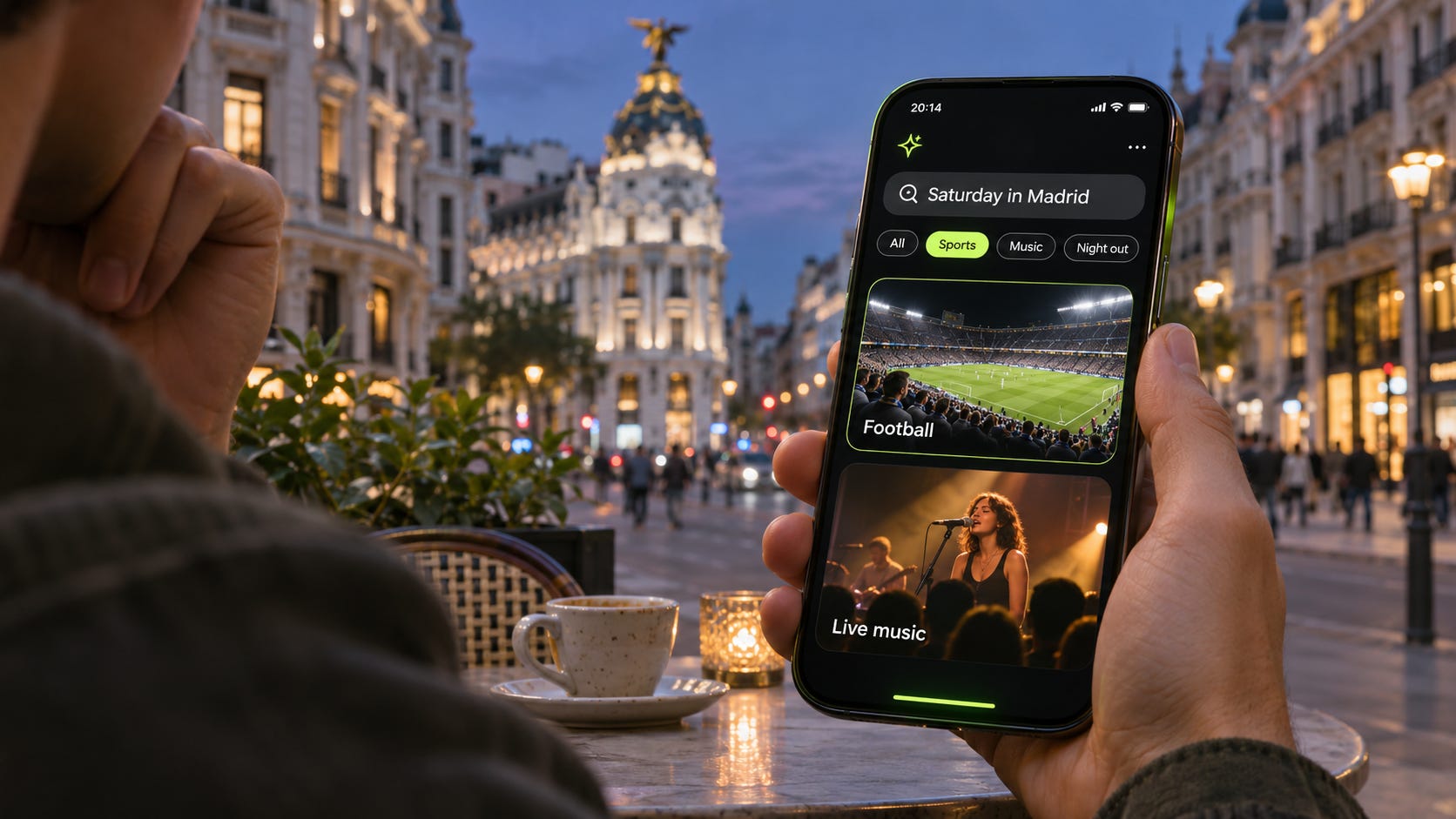
“We’re in Madrid on Saturday. We’d like something lively, easy to reach by metro. We’re open to football or live music. What would you suggest?”
On 21 November 2026, Real Madrid host Celta Vigo at the Bernabéu, while Vetusta Morla play the Movistar Arena. A person planning that evening has plenty to choose from. The question that interests me is how an event becomes one of the options they consider. Real Madrid CF · Vetusta Morla
Someone could add, “There are four of us, and one has never been to a football match.” Or they might decide they want a smaller venue and an earlier finish. They’re working out what they want through the conversation, then judging the suggestions against their own idea of a good evening.
That creates an opportunity to discover something they hadn’t thought of searching for.
On 17 November, Ticketmaster Spain described how fans can discover eligible events in ChatGPT and Claude, explore ticket options and continue to Ticketmaster to buy. Ticketmaster explicitly connects this to reaching people while they are still deciding what to do. Ticketmaster España
I see this as a distribution question for sports and music properties. An assistant can become one of the places where someone first encounters a club, a venue or a festival. How the experience is represented there deserves attention.
I’ve worked on festival marketing and ticket sales, and I’m interested in the people who are still open to different plans. If someone already wants to see a particular artist, they’ve made a large part of the decision. A visitor looking for an enjoyable Saturday in Madrid is giving you a chance to make your event relevant to them.
For me, that starts with positioning. Who would enjoy this experience, and on what occasion would they choose it?
Think of someone considering their first football match. They may want to know what the atmosphere is like, whether they’ll feel comfortable bringing children and how to get home afterwards. A music fan choosing between unfamiliar venues may care about the genre, the size of the room and whether they can sit down. Those are details I’d want our content to explain in terms a visitor would understand.
The way we describe the event matters here. Does our own website explain the experience clearly? Does that come through on the ticketing platform, the venue’s page and relevant city guides? The dates and prices should agree, and the descriptions and photos should help someone imagine being there.
Google’s guidance for AI Mode gives a useful starting point for that work. It recommends making important information available as text, keeping information current and ensuring structured data agrees with what visitors can see on the page. Being eligible to appear still leaves the recommendation itself to Google’s systems. Google Search Central
The ticketing partner has a role in distribution too. I’d want to know which assistants can access our events, what information they receive and where someone goes when they want to buy.
Then I’d try the searches a potential visitor might make, starting without our name. I’d ask about a first visit to the city or an evening out with children, using realistic budgets and times. I’d repeat those searches over time and look at the events suggested, the reasons given and the sources behind the answers.
If our event appeared for the wrong reasons, I’d want to understand which information led to that description. If it rarely appeared for an occasion we genuinely serve well, I’d investigate what information and distribution might be missing.
We’d still need to follow the commercial result. I’d look at whether people who first heard about us through an assistant went on to visit or buy, and whether that brought additional business. That starts with giving a potential customer the chance to discover us while describing the experience they want.
If you asked an assistant to plan an evening in your city, without mentioning your brand, would you expect your event to come up?